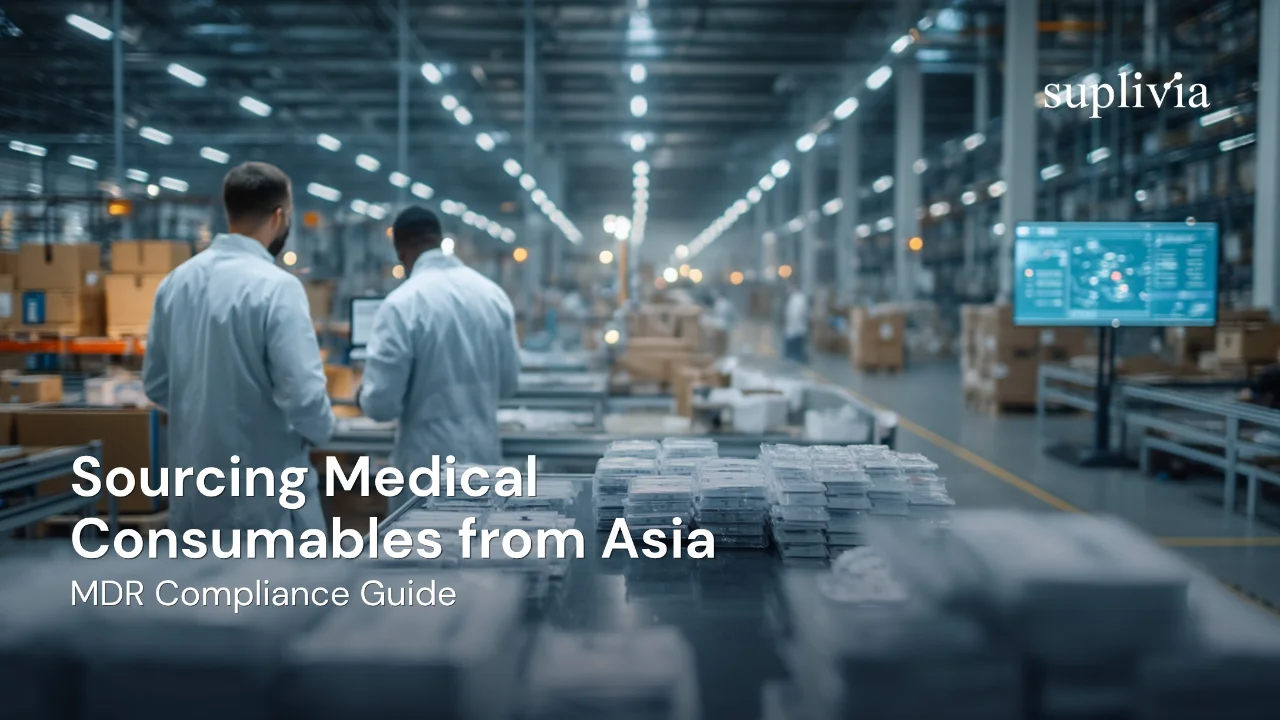
Sourcing medical consumables from Asia offers real cost and volume advantages — but the regulatory stakes have never been higher. EU MDR enforcement, a landmark procurement restriction on Chinese suppliers, and stricter Notified Body audits mean procurement managers must treat compliance as a precondition, not an afterthought. Here is what you need to know before placing your next order.
The Regulatory Landscape Has Shifted Significantly
The EU MDR (Regulation 2017/745) is no longer a future consideration — it is the active compliance framework for all medical devices sold in the EU. Transitional deadlines are staggered through 2028: Class IIb and Class IIa legacy devices must be fully MDR-certified by December 2028, while Class III custom-made devices had a hard deadline of May 2026 (European Commission, 2026).
In parallel, a major procurement restriction took effect on 30 June 2025. Under Implementing Regulation (EU) 2025/1197, Chinese medical device suppliers are excluded from all EU public tenders with a value at or above €5 million. Additionally, any successful non-Chinese tenderer cannot source more than 50% of device content from China. This applies to all EU contracting authorities — hospitals, regional health funds, national procurement agencies — and covers all CPV codes 33100000–1 to 33199000–1 (European Commission, June 2025).
For procurement managers handling public-sector contracts, this is not optional compliance guidance. It is a hard exclusion requirement that must be factored into every supplier selection decision made from mid-2025 onward.
50%
Maximum share of Chinese-origin medical devices permitted in EU public tenders awarded to non-Chinese operators, under Regulation (EU) 2025/1197 effective June 30, 2025
What to Verify Before Contracting Any Asian Manufacturer
Compliance verification must go beyond asking a manufacturer to send their certificates. Fraudulent and outdated MDD-era documents remain in active circulation, particularly from suppliers not yet fully transitioned to MDR. A practical verification process covers five mandatory checks.
- CE certification under MDR, not MDD. Confirm the certificate references Regulation (EU) 2017/745 explicitly. MDD-era certificates are no longer valid for devices entering the EU market as new placements. Check the issuing Notified Body's designation status in the NANDO database before accepting any certificate.
- ISO 13485:2016 certification — verified independently. The certificate should be issued by an accredited body (TÜV SÜD, SGS, BSI, or equivalent). Ask for the full audit scope, not just the cover page. ISO 13485 is required under MDR for all manufacturers, and as of February 2026, the FDA has also incorporated it into its new QMSR regulations (FDA, February 2026).
- EU Authorized Representative appointment. Any manufacturer outside the EU placing devices on the EU market must appoint an EU Authorized Representative (EU AR). This entity assumes legal responsibility alongside the manufacturer. Request the signed mandate document and verify the EU AR is registered in EUDAMED.
- UDI registration in EUDAMED. All devices require a registered Unique Device Identifier before they can be placed on the EU market. Ask for the UDI-DI and verify it in EUDAMED directly. Unregistered devices represent an immediate compliance failure.
- Technical documentation availability. For Class IIa and above, a Notified Body must have reviewed and certified the technical file. The manufacturer should be able to confirm which Notified Body holds their certificate and provide the certificate number for your independent verification.
Sourcing Beyond China: Where Else in Asia to Look
Given the procurement restrictions and increasing Notified Body scrutiny of Chinese documentation practices, many buyers are actively expanding their Asia sourcing to other markets. Several countries offer strong manufacturing bases with established regulatory alignment.
Malaysia requires ISO 13485 compliance for all medical device manufacturers under the Medical Device Act (Act 737), making the certification baseline consistent with EU expectations. Singapore operates one of Asia's most rigorous regulatory environments — the Health Sciences Authority (HSA) requires ISO 13485-compliant quality management systems, and Singapore manufacturers frequently hold dual CE and HSA registrations. South Korea and Japan both have long-standing ISO 13485 traditions and established pathways for EU market entry.
India is an emerging option for consumables such as gloves, syringes, and wound care products. The Central Drugs Standard Control Organisation (CDSCO) has accelerated alignment with ISO 13485, though technical documentation practices are still maturing. Due diligence depth should be higher for Indian manufacturers than for Singapore or Korean equivalents.
Many Asian suppliers have MDD-era documents that were certified on the basis of incomplete or inaccurate technical files. The transition to MDR has exposed this. Procurement managers who rely solely on a certificate scan — without verifying the issuing Notified Body's current designation status — are taking on undisclosed regulatory risk.
Practical Steps for MDR-Compliant Asian Sourcing
Structure your sourcing process around these actions before issuing a purchase order to any new Asian manufacturer.
- Run a NANDO check on every Notified Body referenced in supplier certificates. Designation status changes; a Notified Body suspended or scope-limited after issuing a certificate does not automatically invalidate it, but it requires follow-up with your regulatory team.
- Request the EUDAMED actor registration ID of both the manufacturer and their EU Authorized Representative. Cross-reference it in the live EUDAMED database — not against a document the supplier provides.
- For consumables sourced from China and used in EU public-sector contracts, map your full supply chain origin. The 50% threshold under Regulation (EU) 2025/1197 applies to the value of Chinese-origin content in the overall contract, not just the specific product line.
- Include an MDR compliance warranty clause in your purchase agreements. This should require the supplier to notify you immediately of any certificate suspension, scope change, or EUDAMED registration issue.
- Conduct periodic re-verification — not just onboarding checks. MDR transitional deadlines running through 2028 mean the compliance status of legacy-certified products continues to evolve.
Asian sourcing for medical consumables remains viable and commercially important. The volume capacity, product range, and pricing from manufacturers in China, Malaysia, Singapore, South Korea, and India cannot be replicated domestically in the EU. What has changed is the verification burden on the buyer's side. Procurement managers who build structured compliance checks into their sourcing workflows — rather than treating certification as a one-time onboarding step — will be far better positioned as MDR enforcement tightens through 2028. Manufacturers listed on Suplivia are required to submit verified certification documentation as part of the onboarding process, giving buyers a faster starting point for the verification steps outlined above.